Room Browsing and Selection Experience
Redesigning the Room Types section of Amber's property page from a cluttered, undifferentiated list to a structured decision-making experience.

Amberstudent
Amber is a global student accommodation marketplace with 2M+ beds across 250+ cities in 10 countries. Students search by city or university, explore verified listings, and book directly - often 6–12 months in advance without visiting.
Overview
The accommodation booking journey has three stages: discover → select a room → complete paperwork. The property page is a key decision point where students compare room options, understand value, and book with confidence.
This project focuses on the Room Types section within that experience.
My Role
I owned this project end-to-end across two phases.
In Phase 1 (May 2024 | 1 month), I led discovery, alignment, and design execution. Collaborating cross-functionally while auditing data structures, proposing CMS changes, and defining scalable logic.
In Phase 2 (Sep 2024 | 1 month), I moved into a design lead role - guiding a designer while staying hands-on with QA, consistency, and stakeholder alignment.
Problem
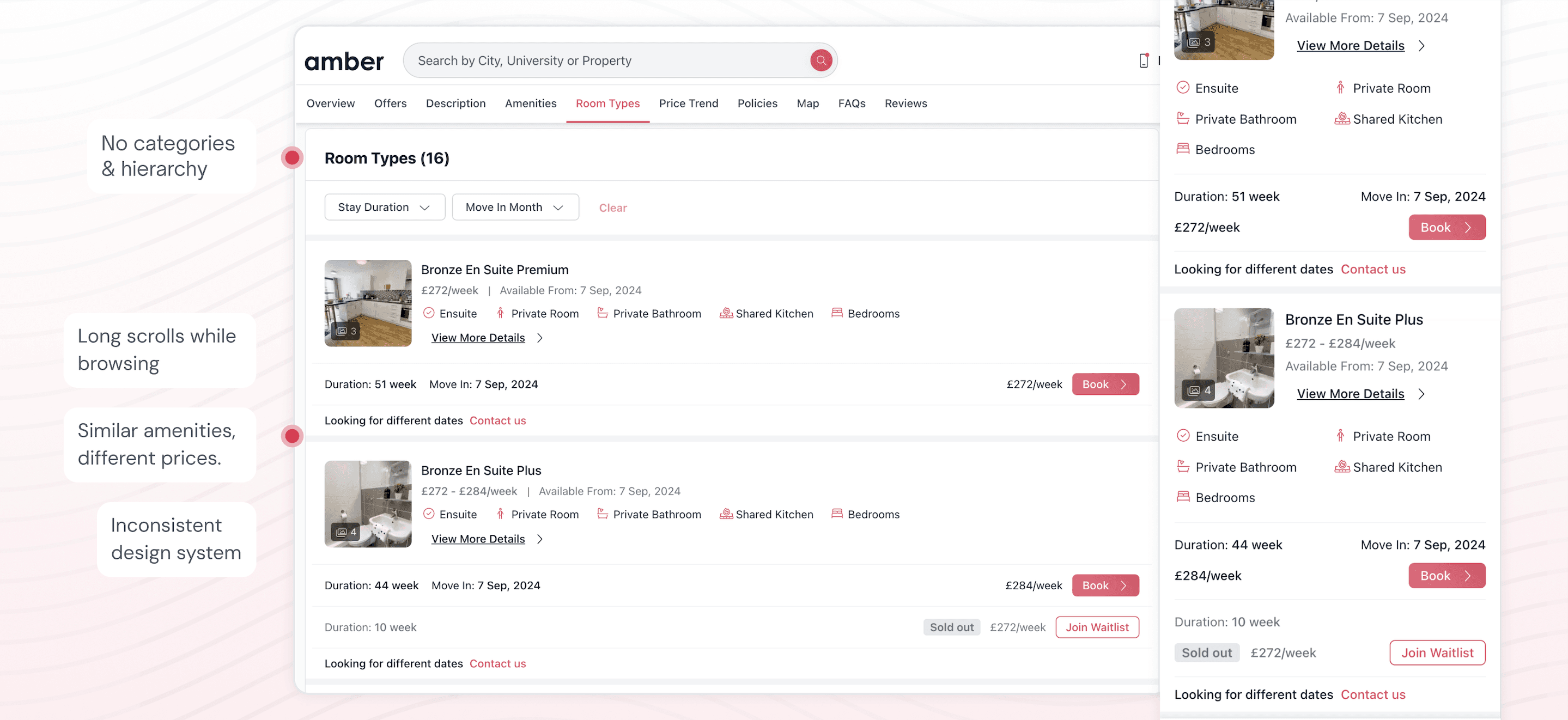
Users couldn’t confidently choose a room because options lacked clear differentiation and comparability, turning selection into confusion rather than a decision. Three signals pointed to the same breakdown in room selection.
Behavioural
Drop-offs at this step, with users scrolling back and forth searching for differences.
Qualitative
Users couldn’t compare options, similar amenity tags across differently priced rooms created confusion.
Sales/Support
Frequent queries like “What’s the difference?” indicated low confidence and high noise.
Problem 1 - No differentiators
Every room type showed identical amenity tags. Key price drivers like floor, area, view existed in the data but were buried in notes fields or hidden at the individual tenancy level, invisible during comparison.
Problem 2 - No orientation upfront.
With up to 16 room types per property, users couldn’t understand the range at a glance, all options were stacked in a single scroll, with no structure or categorisation (unlike evolving industry norms).
NDA
This project is under NDA. The goal was to reduce confusion and improve decision-making during booking, leading to better room browsing and higher progression. I’m happy to share the full process and outcomes in a one-on-one discussion.